AI Is Advancing Faster Than Our Safeguards. Here's What Role Europe Can Play.

Artificial intelligence is improving faster than almost anyone predicted, and faster than our ability to make it safe. Today the frontier of this technology is controlled by a handful of companies in just two countries: the United States and China. However, Europe still holds real sources of leverage, and morally ambitious people in Europe can help push this technology onto a safer, more democratic path.
Of all the numbers used to describe the rise of artificial intelligence, one captures the pace of change more clearly than the rest.
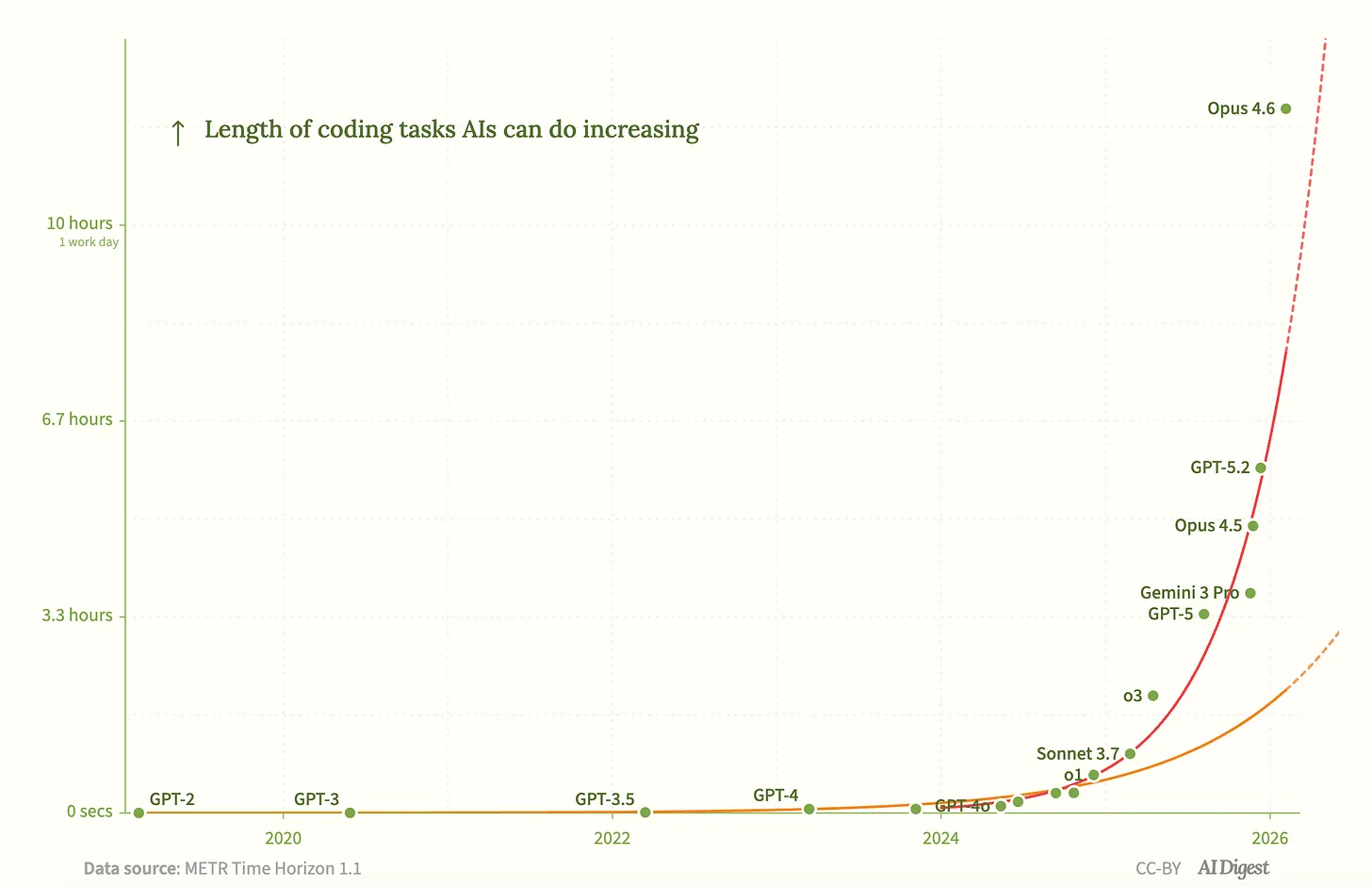
Since 2019, a research group called METR has tracked a single, deceptively simple question: how long a task can an AI system complete on its own, getting it right about half the time? Not a multiple-choice quiz, but real work, measured by how long the same task would take a skilled human.
The trend is startling. In 2022, AI systems could handle work that would take a person about thirty seconds. A year later, it was four minutes. By 2024, forty minutes. In 2025, six hours. Earlier this year, twelve hours. Over the past couple of years, that figure has been doubling roughly every three months.
The consequences of this pace are far-reaching. If machines can do more and more of what skilled people do, and can do it faster every few months, then the question of who builds this technology, who profits from it, and whether anyone can keep it safe will quickly go from being a niche debate to becoming one of the defining issues of our time.
So far, those questions are being answered by a handful of companies in two countries, with most of the world, Europe included, watching from outside the room. But that is not inevitable, and if we act now there is still a chance for us to shape it: to make sure decision makers have independent information rather than only the loudest industry voices, and to back the policy thinkers and founders building safer, more ethical AI.
Faster than the internet
Progress like this used to arrive in fits and starts. That is not the case anymore.
In September 2026, OpenAI announced that one of its internal models had produced a proposed solution to the Navier-Stokes problem, one of the seven Millennium Prize Problems that have stood among the hardest open questions in mathematics for decades. The result has not yet been formally accepted, and it followed years of painstaking work by human mathematicians, but it is a striking demonstration of how far these systems have come.
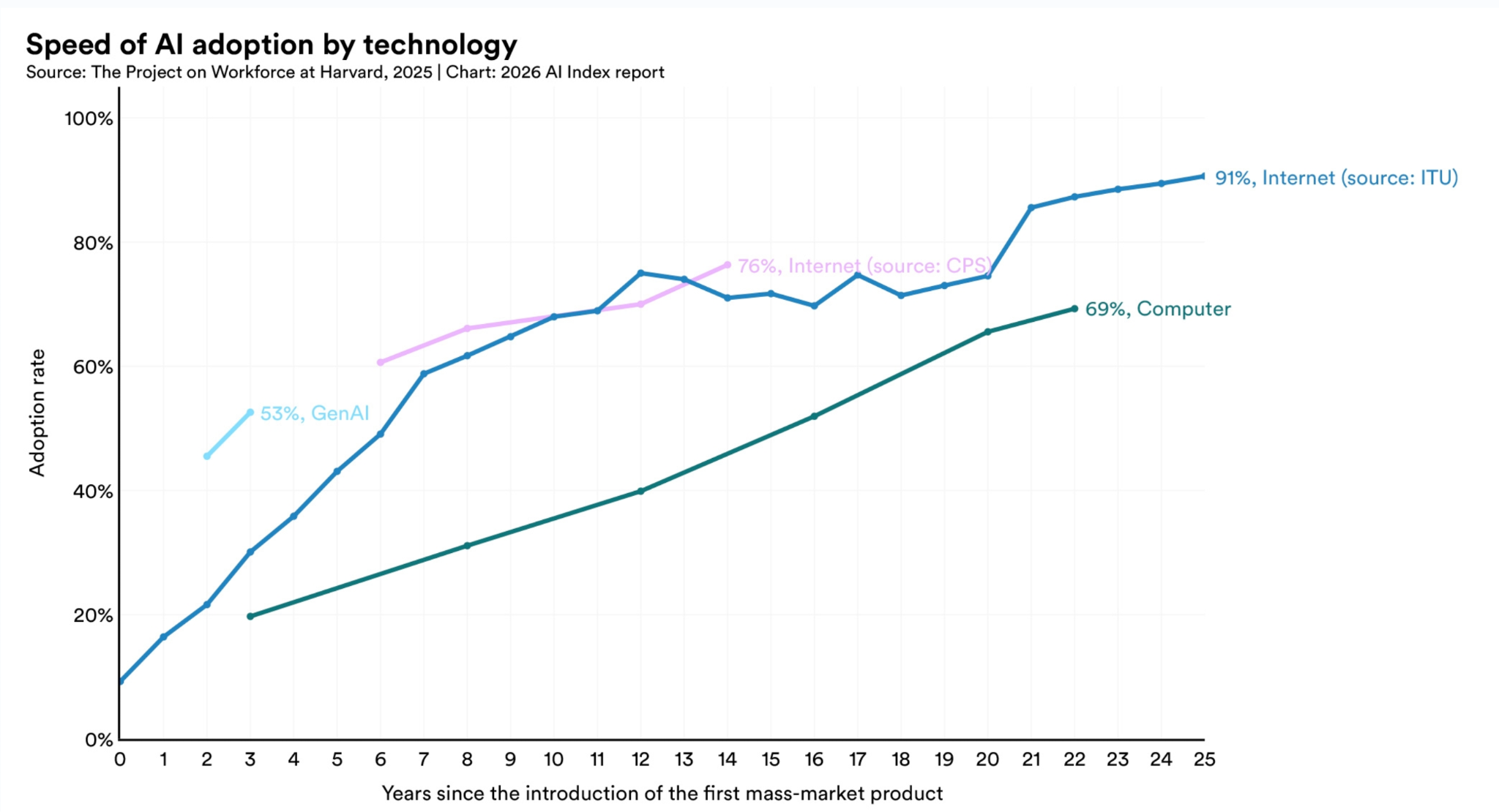
The technology is also spreading faster than any before it. Generative AI, the kind behind tools like ChatGPT, reached half the world's population within three years, quicker than either the personal computer or the internet.
That reach has translated into staggering commercial growth. OpenAI expects its revenue to more than double in 2026, and reached that pace within the first eight months of the year. Anthropic had projected as much as fourfold growth, and by May had already grown more than fivefold.
Some of these companies are not yet profitable, and investors may lose patience with a few of them. But even if some go bankrupt, the progress will not simply stop. The infrastructure, the trained models and the expertise will still be there, just as the dotcom crash of the early 2000s wiped out many companies, but did nothing to slow the internet's march into everyday life.
Why the risks are hard to ignore
So the technology is powerful, and it is here to stay. The harder question is what it will do to the world, and whether anyone is prepared for it.
The most authoritative answer so far came on July 1, 2026, when the UN's Independent International Scientific Panel on AI published its first report. It is the first independent scientific assessment of AI's capabilities, opportunities, and risks produced under a mandate from the UN General Assembly, written by experts drawn from all five UN regions. Its central warning is blunt: our current safeguards cannot keep pace with the growth of AI's capabilities.
The panel cataloged a range of harms that are already appearing or clearly on the horizon. They run from the deeply disturbing to the structural.
AI is already being used to generate child sexual abuse material and to create deepfakes used for sexual violence. Criminals are using it to help mount cyberattacks, and low-skilled actors can now reach for it to assist with fraud, social engineering, disinformation, and even the basics of biological or financial manipulation. Researchers still have no reliable way to keep highly autonomous systems, the so-called AI "agents" that can act on their own, under firm control, with no guarantee they will follow instructions. And at a broader level, the panel warned that concentrating this much capability in a few firms and countries could hand disproportionate power to whoever controls it, widen inequality, and shift wealth from workers to the owners of the technology.
None of this means the technology is bad. AI could bring enormous benefits, but those benefits only arrive if the risks above are confronted rather than waved away. For anyone who wants their career to count, that gap, between what AI could do and what it might do if left unchecked, is exactly where the work is.
Two countries, a handful of companies
Here is the uncomfortable reality. Two countries, driven by the interests of a handful of companies, hold the real power to decide the future of this technology. The United States and China are increasingly discussing AI safety between themselves, while Europe and the rest of the world are left on the sidelines, even though the outcome will affect every person on the planet.
On the current balance of power, Europe's position looks weak.
Its strongest homegrown model, built by the French company Mistral, is barely visible on a chart of the industry's revenue, and it is falling further behind even the leading Chinese open-weight models, meaning models whose inner workings are published openly for anyone to build on. This concentration of power, in two countries and a few firms, is exactly one of the risks the UN panel singled out.
What Europe can still do
And yet Europe is not powerless. There are three ways in which morally ambitious people here can push this technology in a better direction.
Build on the strengths Europe already has. Look beyond the models themselves to the wider "AI stack", the layers of hardware and infrastructure needed to build them, and a different picture emerges. ASML, the most valuable company in Europe, makes the extreme ultraviolet lithography machines: extraordinarily complex tools that print the microscopic circuitry onto essentially every advanced AI chip made in the Western world. It sits at the heart of a Dutch semiconductor ecosystem full of critical suppliers, alongside companies like Germany's Zeiss, which holds a near-monopoly on the precision lenses those machines depend on. The catch is that these strengths sit in individual countries, which limits how much leverage any one of them has alone. To turn them into real influence, Europe and like-minded partners will need to protect, build, pool, and share these resources together.
Deploy AI for the people who live here. Used carefully, with strong guardrails, the technology could improve the lives of the EU's 450 million residents. The task is to capture those gains while shielding citizens from sudden shocks to the job market, so that the benefits are shared widely rather than captured narrowly.
Build the capacity to keep AI in check. Europe needs more founders working on safety, and public institutions able to evaluate these systems independently, rather than taking the developers' word for how safe their own products are. That is the thinking behind the national AI Security Institutes now launching across the continent, public bodies set up to test and scrutinize advanced AI. Europe's semiconductor strength offers another lever: the chance to build what is sometimes called "assured compute", a reliable and trusted supply of the computing power needed to run and check these systems.
The story of AI is often told as though the ending is already written, decided in a few boardrooms and government meetings far from here. It is not. The technology is moving fast, the stakes could hardly be higher, and the people who will shape what comes next are still deciding where to put their talents. Europe does not have to watch from the sidelines. It needs builders, researchers, founders, and advocates who are willing to take this on. That is the work ahead.
• • •
What role does The School for Moral Ambition play?
We want to enable more people in Europe to work on the challenges above. For now, we have decided not to run a dedicated Fellowship, and to use other tools instead to help talent get to work. We are testing several activities to find where we can add the most value: connecting domain experts to decision makers; giving public and private researchers grants to work on these questions, since a fast-moving field needs policy grounded in the latest evidence; helping talented founders find their project, their funders and their co-founders; making sure the most important arguments are heard in public debate; and supporting projects and groups that share our mission with advice, connections, and resources.
Heading 1
Heading 2
Heading 3
Heading 4
Heading 5
Heading 6
Lorem ipsum dolor sit amet, consectetur adipiscing elit, sed do eiusmod tempor incididunt ut labore et dolore magna aliqua. Ut enim ad minim veniam, quis nostrud exercitation ullamco laboris nisi ut aliquip ex ea commodo consequat. Duis aute irure dolor in reprehenderit in voluptate velit esse cillum dolore eu fugiat nulla pariatur.
Block quote
Ordered list
- Item 1
- Item 2
- Item 3
Unordered list
- Item A
- Item B
- Item C
Bold text
Emphasis
Superscript
Subscript
Heading 1
Heading 2
Heading 3
Heading 4
Heading 5
Heading 6
Lorem ipsum dolor sit amet, consectetur adipiscing elit, sed do eiusmod tempor incididunt ut labore et dolore magna aliqua. Ut enim ad minim veniam, quis nostrud exercitation ullamco laboris nisi ut aliquip ex ea commodo consequat. Duis aute irure dolor in reprehenderit in voluptate velit esse cillum dolore eu fugiat nulla pariatur.

Block quote
Ordered list
- Item 1
- Item 2
- Item 3
Unordered list
- Item A
- Item B
- Item C
Bold text
Emphasis
Superscript
Subscript